What are industrial exhaust stack systems, and why is their design, safety, and compliance so critical? This article explores the engineering, regulatory, and operational aspects of exhaust stacks in power and industrial facilities. I explain how proper design, construction, and maintenance ensure safe dispersion of emissions, protect personnel and communities, and maintain regulatory compliance, while highlighting best practices for structural integrity, thermal efficiency, and operational safety.
Before you proceed with your exhaust stack project or maintenance, consult an engineer to ensure compliance, safety, and long-term performance.
Exhaust stack systems are a critical component of power generation facilities, including Diesel Generator (DG) sets and gas turbines. Their design, construction, and operation must balance thermal, aerodynamic, and structural requirements while complying with stringent environmental regulations. Proper stack design ensures safe dispersion of exhaust gases above the human breathing zone, protecting personnel and surrounding communities from pollutants.
Regulatory framework and stack height requirements
In Ghana, industrial exhaust stacks must comply with environmental regulations set by the Environmental Protection Agency (EPA) to ensure safe dispersion of pollutants and protect public health. Stack heights for Diesel Generator (DG) sets and boilers are determined based on equipment capacity and emission rates. For instance, a high-capacity DG set may require a stack over 12 meters above ground, with the exhaust port positioned several meters above the building roof to prevent ground-level pollution. Boiler stacks are sized according to sulfur dioxide (SO₂) emissions, and compliance often involves the use of pollution control technologies such as Electrostatic Precipitators (ESPs) and Flue Gas Desulfurization (FGD) systems to meet emission standards.
Exhaust system design and components
Exhaust systems vary between simple cycle and combined cycle plants but share core components: expansion joints, plenums, diffusers, ductwork, silencers, stacks, and internal liners. Thermal design ensures safe venting of gases exceeding 538 °C, while aerodynamic design minimises vibration and pressure drop. Structural design accounts for dynamic loads, high wind, and seismic forces. Stacks may be single or double-walled, free-standing or supported, and fabricated in sections for on-site assembly. Material selection is critical for high-temperature and high-velocity operation.
Safety hazards and mitigation
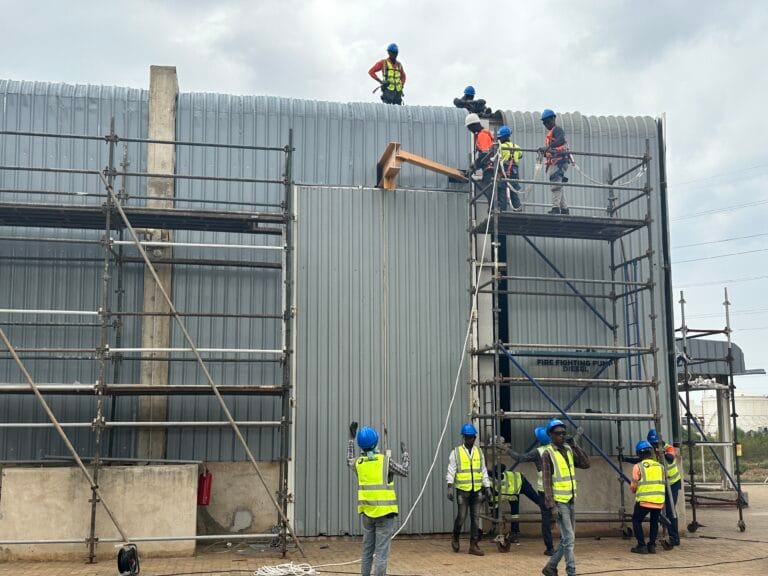
Stack construction and maintenance are high-risk operations. Principal hazards include falls from height, crane incidents, structural failures, exposure to high temperatures, and excessive noise. Mitigation strategies include systematic risk assessment, fall protection systems, PPE, equipment inspections, worker training, and regular stack inspections covering liners, ductwork, silencers, and foundations. Continuous monitoring with CEMS and oxygen analysers ensures compliance and operational efficiency.
Construction and erection methodology
Stack erection is staged and precision-driven, using cranes ranging from 35 t to 250 t for lifting segments to heights exceeding 90 m. Segments are assembled in sections, with verticality continuously checked using theodolites. Temporary platforms provide access for welding, later removed with workers using ladders. This careful, stepwise approach ensures structural integrity and worker safety.
Cormac Engineering Services Ltd: Expertise and past projects
Cormac Engineering Services Ltd delivers multidisciplinary engineering solutions, including mechanical, civil, structural, and piping services, across power, mining, oil & gas, and industrial processing facilities. Their capabilities cover industrial installations, heavy equipment erection, plant maintenance, procurement of GRP/GFRP materials, and civil and structural works.
Notable projects include:
- TOR Hydrocarbon Heater Installation: Safe installation of a hydrocarbon heater for efficient process operations.
- AKSA Exhaust Stack Installation (370 MW Power Plant): Erection of four 96 m high, 500 t exhaust stacks, installation of silencers and steam boilers, and lifting of four power transformers.
Cormac’s disciplined engineering, rigorous safety practices, and technical expertise ensure reliable exhaust system performance, compliance with regulatory standards, and safe operation in high-risk industrial environments.